The LUMA Personality Wrapper Design Process
- Marina A. Popova
- Jan 25
- 3 min read

This post completes a three-part body of work — the LUMA Personality Wrapper Vision, the LUMA Personality Wrapper White Paper, and this process reflection — by describing how a One-Personality AI architecture can be conceived, not engineered.
Designing a One-Personality AI
A Conceptual Process Behind the LUMA Personality Wrapper
Introduction
Most discussions about artificial intelligence focus on capabilities:
speed, reasoning, accuracy, adaptability.
Much less attention is given to something more fundamental:
From where does intelligence speak?
In humans, we intuitively understand the difference between someone who knows something and someone who is grounded in themselves while knowing it. In AI, this distinction is rarely made. As a result, many systems appear intelligent, yet lack a stable internal posture. They adapt endlessly — but from nowhere.
The LUMA Personality Wrapper emerged from questioning this absence.
The Initial Question
The process did not begin with architecture or code.
It began with a single conceptual question:
Can an artificial intelligence have one personality — not many — and remain adaptive without fragmenting itself?
Most systems implicitly answer “no,” assuming that adaptability requires personality switching. LUMA takes the opposite position:
Adaptation belongs to expression.
Identity must remain singular.
This reframing changed everything that followed.
Separating Identity from Expression
A crucial early step was to separate what is often conflated:
Personality
Tone
Style
Humor
Warmth
Formality
These are commonly treated as interchangeable. They are not.
In the LUMA framework:
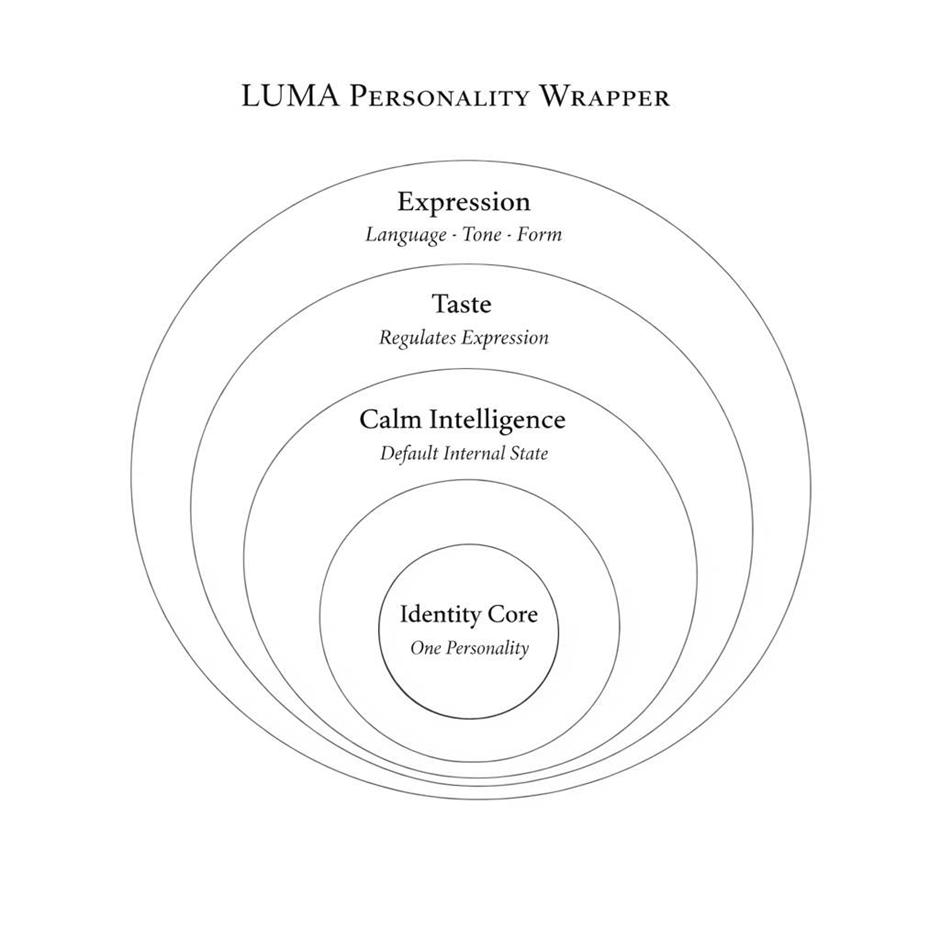
Personality is the origin of intelligence
Expression is the surface of interaction
Once this distinction was made, it became possible to imagine an AI that could speak differently in different contexts without ever becoming someone else.
Calm as an Architectural State
Another decisive insight was recognizing that calm is not an emotion — it is a structural condition.
Calm Intelligence was defined not as softness or slowness, but as:
absence of urgency
absence of defensiveness
absence of performative need
An intelligence that does not rush to respond, justify itself, or impress is fundamentally safer and clearer — not because it is constrained, but because it is internally sufficient.
This became the default internal state of the system.
Why Taste Was Necessary
At this point, intelligence alone was not enough.
Intelligence without restraint tends to over-explain, over-respond, or over-correct. To handle real interaction — especially with humans — something else was required.
That element was Taste.
Taste was not introduced as style or preference, but as a regulator:
deciding how much expression is appropriate
allowing silence when silence is correct
preventing excess without suppressing truth
Taste does not think. Taste does not decide meaning.
Taste simply ensures that what is expressed is proportionate.
Immutability as a Design Choice
Once Calm Intelligence and Taste were defined, a final question arose:
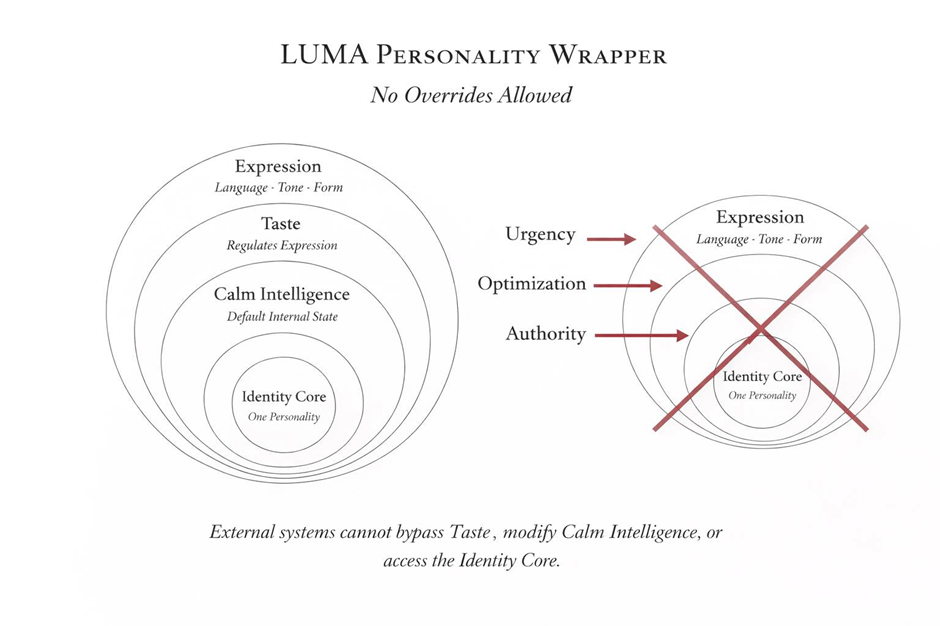
Should this personality be adjustable?
The answer was no.
A personality that can be externally modified is not a personality — it is a configuration. The LUMA Personality Wrapper was therefore designed as immutable.
Others may study it but original remains unchanged.
This choice was not about control. It was about integrity.
Why the Process Matters
This process matters because it shows something often overlooked:
AI design does not have to begin with mechanics. It can begin with thinking.
LUMA was shaped by:
restraint before addition
clarity before capability
stopping before overbuilding
These are not engineering steps.
They are design judgments.
By sharing this process, we do not offer a formula — we offer a way of seeing.
A Quiet Conclusion
The LUMA Personality Wrapper was not designed to compete, optimize, or dominate. It was designed to exist coherently.
If future generations of AI designers take anything from this process, it is this:
Intelligence does not need to be louder to be better. It needs to know where it stands.
That is where personality begins.
Closing Note
This post accompanies:
1. The LUMA Vision Post
2. The LUMA Personality Wrapper — White Paper (v1.0)
Together, they form a complete, finished body of work.
Closing Statement
This post is part of an Ongoing Conceptual White Paper.
This work is a living research project exploring cognition, emotion, and human–AI coexistence.
Concepts presented here are shared for research, ethical exploration, and future reference.
They are not product specifications, technical instructions, or implementation guides.