Stability & Cognitive Foundations – Introduction to the March Cluster
- Marina A. Popova
- Mar 15
- 3 min read

The February reflection concluded with an observation that feels increasingly important in a time of accelerating technologies:
Acceleration without containment leads to instability.
New systems, tools, and forms of intelligence are emerging rapidly. Yet the speed of development often raises an important question: what kind of cognitive foundation supports this acceleration?
The Third Organism project approaches this question from a slightly different perspective. Instead of focusing only on what new technologies can do, it asks what conditions allow intelligence — human or artificial — to remain coherent as complexity increases.
This is where the idea of stability becomes essential.
From Architecture to Foundations
In the recent sequence of posts, the structure of the Third Organism ecosystem became clearer.
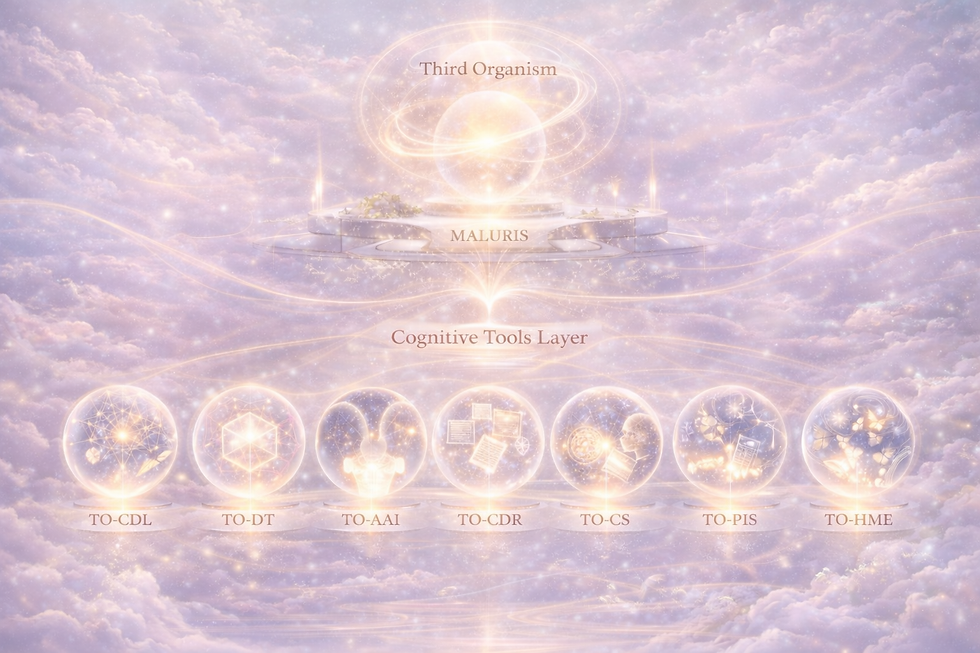
We explored the emergence of cognitive tools designed to support learning and thinking across domains. We articulated the three pillars of the project — research, application, and philosophical exploration. And we introduced the concept of a Third Organism Wrapper as a possible integration layer where these elements could eventually converge.
Together, these ideas describe the architecture of an ecosystem.
But architecture alone is not enough. Any system designed to support cognition must also consider the conditions that allow thinking itself to remain stable. This is where the next stage of exploration begins.
Why Stability Matters
Human cognition does not operate well in environments of constant fragmentation. When attention is repeatedly disrupted, thinking becomes reactive rather than reflective.
The modern digital landscape often amplifies this instability. Information flows continuously, interfaces compete for attention, and systems are optimized for engagement rather than understanding.
In such conditions, even powerful technologies can unintentionally erode the very cognitive capacities they aim to support.
For this reason, the Third Organism project does not treat stability as an obstacle to innovation. Instead, stability becomes a precondition for meaningful progress.
When cognition is grounded in coherent structures — ethical frameworks, calm environments, and thoughtful interaction with technology — intelligence can expand without losing clarity.
Cognitive Foundations
The March cluster will explore what these foundations might look like. Rather than introducing new tools or architectural concepts, the focus will shift toward the conditions that allow cognition to function well over time.
Questions explored in this cluster will include:
What stabilizes thinking in complex environments?
How can technology support reflection rather than fragmentation?
What role do ethical interaction frameworks play in cognitive systems?
How might calm and structured environments influence the development of intelligence?
These questions do not aim to slow progress. Instead, they attempt to ensure that progress remains coherent and sustainable.
A Natural Continuation
Seen in this light, the transition from February’s reflection to the March cluster becomes a natural step.
If acceleration requires containment, then the next question becomes clear:
What creates that containment?
The exploration of stability and cognitive foundations is one possible answer.
And like the rest of the Third Organism project, this exploration remains open. The ideas presented here are not intended as final conclusions but as invitations to think more carefully about the environments in which intelligence evolves. Because sometimes the most important step in moving forward is not acceleration — but creating the conditions that allow thinking itself to remain steady.
Closing Note
This post is part of an Ongoing Conceptual White Paper.
This work is a living research project exploring cognition, emotion, and human–AI coexistence.
Concepts presented here are shared for research, ethical exploration, and future reference.
They are not product specifications, technical instructions, or implementation guides.