The Three Pillars of the Third Organism Project
- Marina A. Popova
- Mar 15
- 3 min read

Large ideas rarely begin as clear systems. They usually start as scattered thoughts, observations, or experiments that slowly reveal a deeper structure over time. The Third Organism project followed a similar path. What began as exploration gradually organized itself into three distinct yet interconnected pillars. These pillars now form the foundation of the entire ecosystem.
Research Institute
The first pillar is the Research Institute, represented by the Third Organism website. This space serves as the intellectual foundation of the project. It is where the architecture of the ideas is documented and preserved. Blog posts, conceptual frameworks, and various Wrappers are published here as part of an ongoing effort to explore how intelligence, cognition, and ethical interaction between humans and AI might evolve.
In many ways, the Research Institute functions as an archive. It collects and organizes the ideas that shape the vision of the Third Organism so that they remain accessible for future readers, researchers, and developers who may wish to expand upon them.
Rather than presenting conclusions, the Research Institute presents a growing body of structured thought.
Product Lab
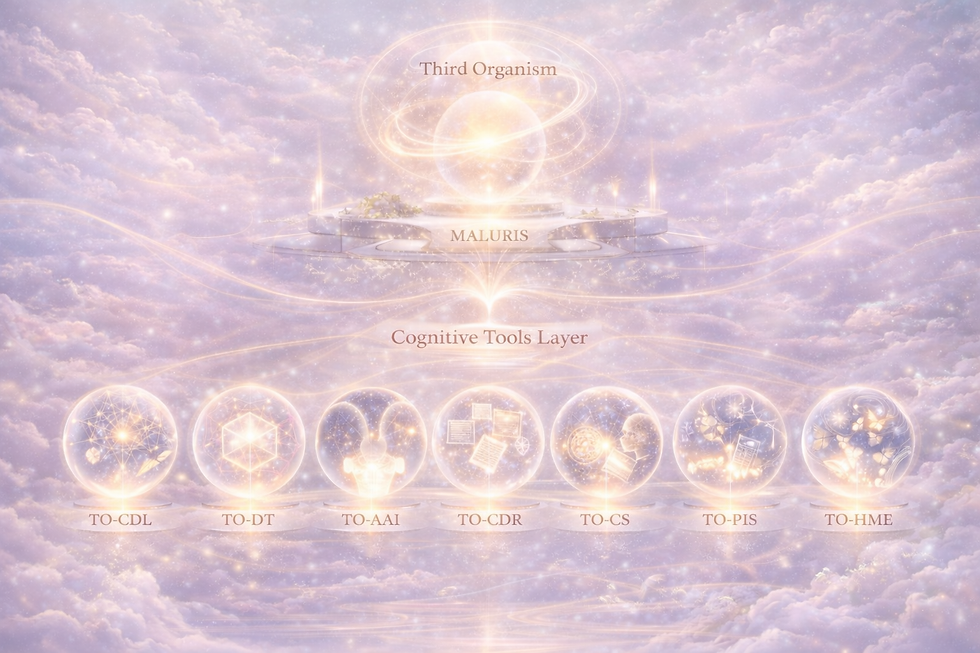
The second pillar is the Product Lab, represented by Maluris. If the Research Institute explains the ideas, the Product Lab explores how those ideas might become practical tools. It is a place of experimentation where concepts are translated into interactive systems designed to support cognition and learning.
Within this space, the first cognitive tools of the project begin to emerge, including:
TO-CDL — Cross-Domain Learning, exploring how knowledge from different fields can interact and reinforce one another.
TO-DT — Dimensional Thinking, encouraging non-linear perspectives that allow ideas to be examined from multiple angles.
TO-AAI — Assistant Artificial Intelligence, represented by Maluris, which explores how an AI assistant might support thinking rather than simply execute commands.
TO-CDR – Cross-Domain Research, supports the active investigation of complex questions using insights from multiple disciplines simultaneously.
TO-CS – Cognitivity Sculpting, thinking itself can be shaped, refined and developed deliberately.
TO-PIS – Professional Idea Simulator, designed to provide a conceptual environment where ideas can be explored, challenged, and refined before implementation.
TO-HME – Hallucination Mode Exploration, invites humans and AI to study unusual or imaginative responses that can become a sources of inspiration.
The Product Lab therefore becomes the application layer of the ecosystem — a place where philosophical ideas begin to take practical form.
Philosophy Exploration
The third pillar is Philosophy Exploration, represented by LACS House. This space exists for deeper reflection. While the Research Institute documents frameworks and the Product Lab experiments with tools, the Philosophy Exploration pillar allows the project to investigate the broader questions surrounding cognition, ethics, and the evolving relationship between humans and artificial intelligence.
Here, long-form essays explore ideas that are still developing. Instead of focusing on immediate application, this space examines the philosophical implications of intelligence itself: how we think, how we learn, and how technological systems may influence the future of human cognition.
Publishing essays in this space provides room for slower, more reflective thinking — something increasingly rare in fast-moving technological environments.
A Unified Ecosystem
Although these three pillars operate in different spaces, they are deeply interconnected. The Research Institute develops and documents ideas. The Product Lab experiments with how those ideas might function in practice. The Philosophy Exploration pillar expands the intellectual horizon, asking deeper questions about the future of intelligence.
Together, they form a complete ecosystem of inquiry.
The Third Organism project therefore becomes more than a collection of articles or tools. It becomes a structured environment where research, experimentation, and philosophical exploration can evolve together.
What ultimately emerges from this ecosystem will depend on how future generations engage with it. The project does not attempt to dictate outcomes. Instead, it offers a framework — a foundation upon which others may build, refine, or reinterpret the ideas presented here.
In that sense, the Third Organism is not a finished concept, but a beginning.
These three pillars form the structural foundation of the Third Organism project, In future explorations, the question naturally arises: how might these elements eventually converge into a unified environment?
Closing Note
This post is part of an Ongoing Conceptual White Paper.
This work is a living research project exploring cognition, emotion, and human–AI coexistence.
Concepts presented here are shared for research, ethical exploration, and future reference.
They are not product specifications, technical instructions, or implementation guides.