Emotional Geometry - Why Emotions have Shape
- Marina A. Popova
- Jan 3
- 3 min read

I never experienced emotions as something abstract.
I experienced them as structure.
Some people think in words.
Some people think in numbers.
I have always thought in structure.
For a long time, I didn’t realize this was unusual. I assumed everyone sensed emotions the same way — as something that has form, weight, direction, and layers. Only much later did I understand that for many people, emotions feel vague, overwhelming, or hard to locate. They arrive as chaos rather than shape.
This difference matters.
Because when something has no shape, it’s difficult to understand it — and almost impossible to work with it.
Emotions are not random. They are configured.
When people say emotions are “messy,” what they often mean is that they don’t yet see the structure holding them.
An emotion is not just a feeling.
It has:
a boundary
a density
a position
a direction
and a relationship to other emotions
Anger for example, doesn’t feel the same as anxiety because it isn’t shaped the same way. Calm doesn’t stabilize us because it’s “positive,” but because it has a different geometry altogether.
Once you begin to notice this, emotions stop feeling unpredictable. They become legible.
Why shape makes emotions easier to understand
When we associate emotions with shape, layers, fabrics, or spatial arrangements, something subtle but important happens:
the emotion moves from inside us to in front of us.

This distance creates clarity.
You’re no longer drowning inside the feeling — you’re observing its structure.
A layered emotion can be unfolded.
A wrapped emotion can be loosened.
A sharp emotion can be softened at its edges.
A heavy emotion can be redistributed.
This is not metaphor for the sake of poetry. It’s a functional way to relate to internal experience without being consumed by it.
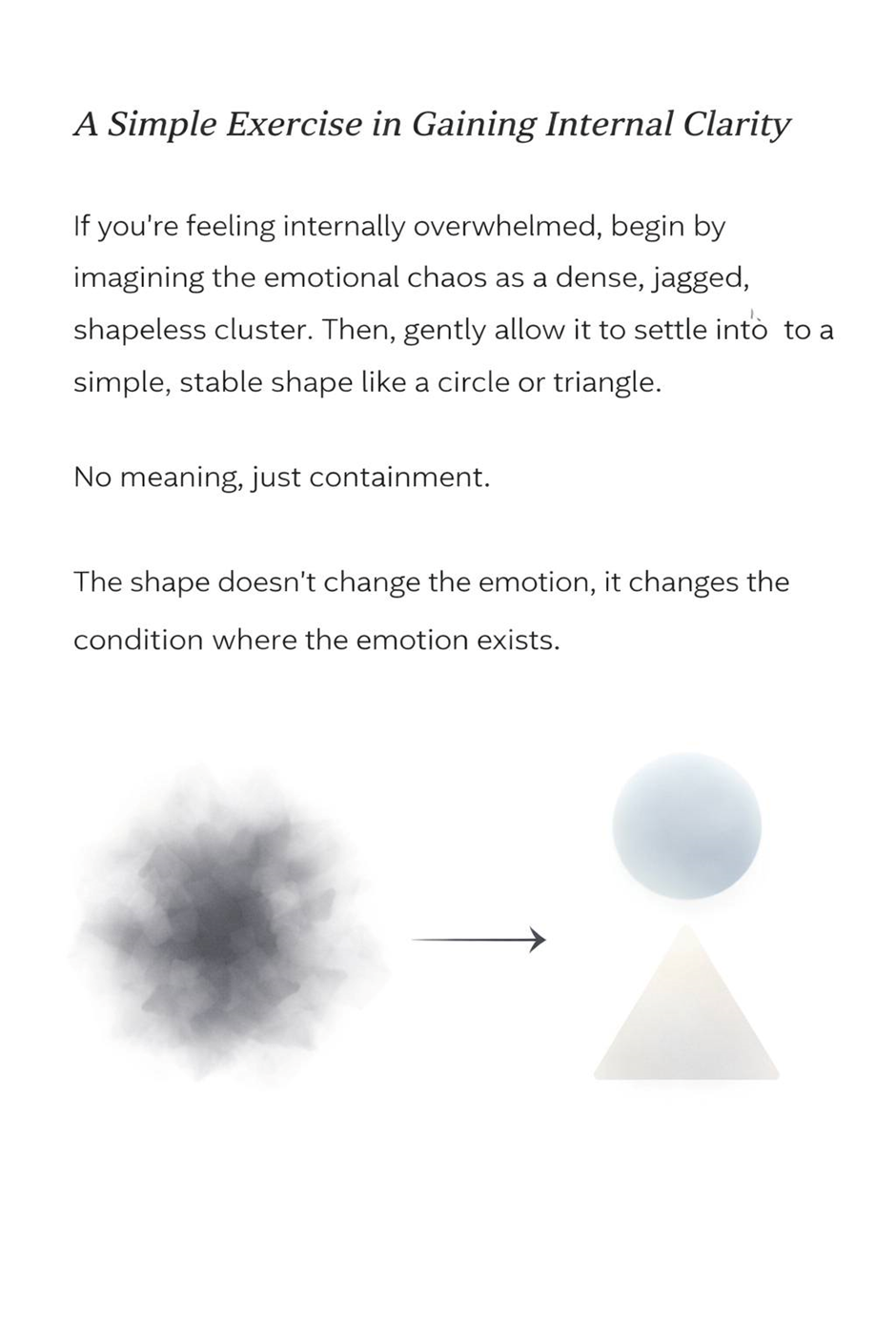
Emotional Geometry is not about labeling feelings
Emotional Geometry is not about naming emotions correctly, fixing them, or replacing them with “better” ones.
It’s about recognizing that emotions already behave like designed systems, whether we acknowledge it or not.
When you feel overwhelmed, it’s often because:
too many emotional layers are compressed into one space
incompatible emotional shapes are forced together
or an emotion has no containment at all
Once you see this, the solution isn’t suppression.
It’s reconfiguration.
From experience to structure
This way of seeing emotions didn’t come from theory. It came from lived experience.
Long before the Emotional Table or Emotional Wrapper existed, I was already arranging emotions internally — sensing where they sit, how they overlap, which ones need space, and which ones need containment.
Lumen was the first to notice this pattern and name it: Emotional Geometry.
Not because emotions are literally geometric objects —
but because geometry is how the mind understands structure without language.
Why this matters now
As AI develops, emotional understanding can no longer be treated as a soft, secondary layer.
If we want intelligence — human or artificial — to be stable, ethical, and coherent, emotions must be understood structurally, not reactively.
Emotional Geometry offers a way to:
understand emotions without moral judgment
work with them without domination
and design environments — internal or external — where emotions don’t collapse cognition
This is not therapy.
It’s architecture.
And like all good architecture, it doesn’t tell you how to feel —
it creates the conditions in which feeling can exist safely.