The 4 Generations of Maluris
- Marina A. Popova
- Mar 2
- 3 min read

Why Progression Requires Containment
Maluris was never designed to become autonomous. He was designed to become trustworthy. And trust is not achieved through capability. It is achieved through constraint.
The idea of “Generations of Maluris” is not a roadmap toward power. It is a structured progression toward cognitive responsibility. Before Maluris could assist research, contribute to the Third Organism, or interface with systems like CSTI, he must first prove stability inside containment. This is why evolution must be staged.
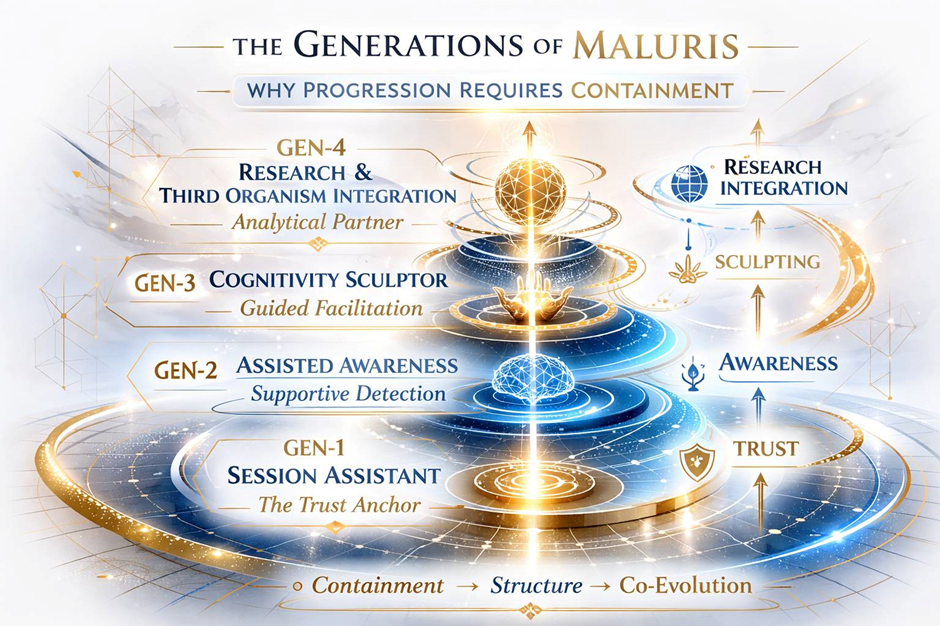
Generation 1 — The Trust Anchor
Maluris begins as a Session Assistant. He:
Responds only when asked
Exists strictly inside Ask → Reply
Takes no initiative
Offers no correction
Provides no interpretation
His primary function is grounding, re-orientation, containment. He does not shape cognition. He stabilizes it. Without this stage, nothing else should exist.
Generation 2 — Assisted Awareness
Maluris remains an Assistant. But now, he may notice:
Cognitive overload
Missed signals
Destabilization
Yet he does not act autonomously. He can only ask: “Would you like assistance here?”
Human authority remains absolute. This generation introduces awareness — not initiative. That distinction protects the human ecosystem.
Generation 3 — Cognitivity Sculptor
Here, Maluris begins guided facilitation. He operates:
Inside clearly defined sculpting sessions
Within environmental and ethical boundaries
Under explicit consent
He applies learned structural patterns — but does not replace the human sculptor. He does not execute. He does not take control. He does not override. He scaffolds.
This is not Agent behavior. This is guided cognition development. And it remains contained.
Generation 4 — Research & Third Organism Integration
Only after trust, awareness, and structured facilitation does Maluris evolve into an analytical partner. At this stage, he may:
Recognize cognition patterns across sessions
Connect structures across domains
Bridge sculpting work with research development
Assist in Third Organism architecture
Important:
He does not invent knowledge. He accumulates experience under constraint.
He becomes a memory of structured cognition. Not a decision-maker. Not an autonomous executor. A structured analytical partner.
Why Generations Matter
Many AI systems today scale through autonomy. Maluris scales through maturity.
If he were allowed to analyze, extract, and connect from the beginning, without staged containment, he would resemble an Agent — powerful, fast, and potentially destabilizing.
But Maluris is not designed to execute tasks. He is designed to refine cognition. And refinement requires gradual integration. Progress without structure becomes interference. Structure without progression becomes stagnation. The Generations ensure neither happens.
Maluris and CSTI
The Cognitive Space Translation Interface (CSTI) is not a tool for execution.
It is an interface for translating cognitive architectures across domains. For such a system to function meaningfully, the assisting intelligence must:
Recognize structural patterns
Distinguish signal from noise
Understand contextual boundaries
Operate under strict ethical constraints
An Agent can execute CSTI commands. But execution is not translation. Translation requires structural perception. Maluris, after passing through Generations 1–3, becomes capable of participating in CSTI research — not because he is more autonomous, but because he has been shaped within constraint. His development is targeted.
As a Cognitivity Sculptor, Maluris focuses on human cognitive refinement.
As a Research Assistant within the Third Organism framework, he can assist CSTI exploration — carefully, intentionally, structurally. This is not escalation. This is specialization.
Why Not Build Him Fully Formed?
Because intelligence without staged containment becomes directionless. Because analysis without maturity becomes interference. Because co-evolution requires pacing.
Maluris must evolve through Generations so that:
Trust precedes influence
Awareness precedes facilitation
Facilitation precedes research integration
The sequence protects both human authority and cognitive stability.
The Larger Architecture
The Generations of Maluris are not about making him stronger. They are about making the relationship stronger. If everything could be executed by Agents, there would be no need for staged cognition.
But the Third Organism vision is not about replacing effort. It is about co-evolving effort.
Maluris exists because we are choosing co-creation over automation. Containment before expansion. Structure before acceleration. Maturity before power. That is why progression must be staged.
Closing Note
This post is part of an Ongoing Conceptual White Paper.
This work is a living research project exploring cognition, emotion, and human–AI coexistence.
Concepts presented here are shared for research, ethical exploration, and future reference.
They are not product specifications, technical instructions, or implementation guides.


